

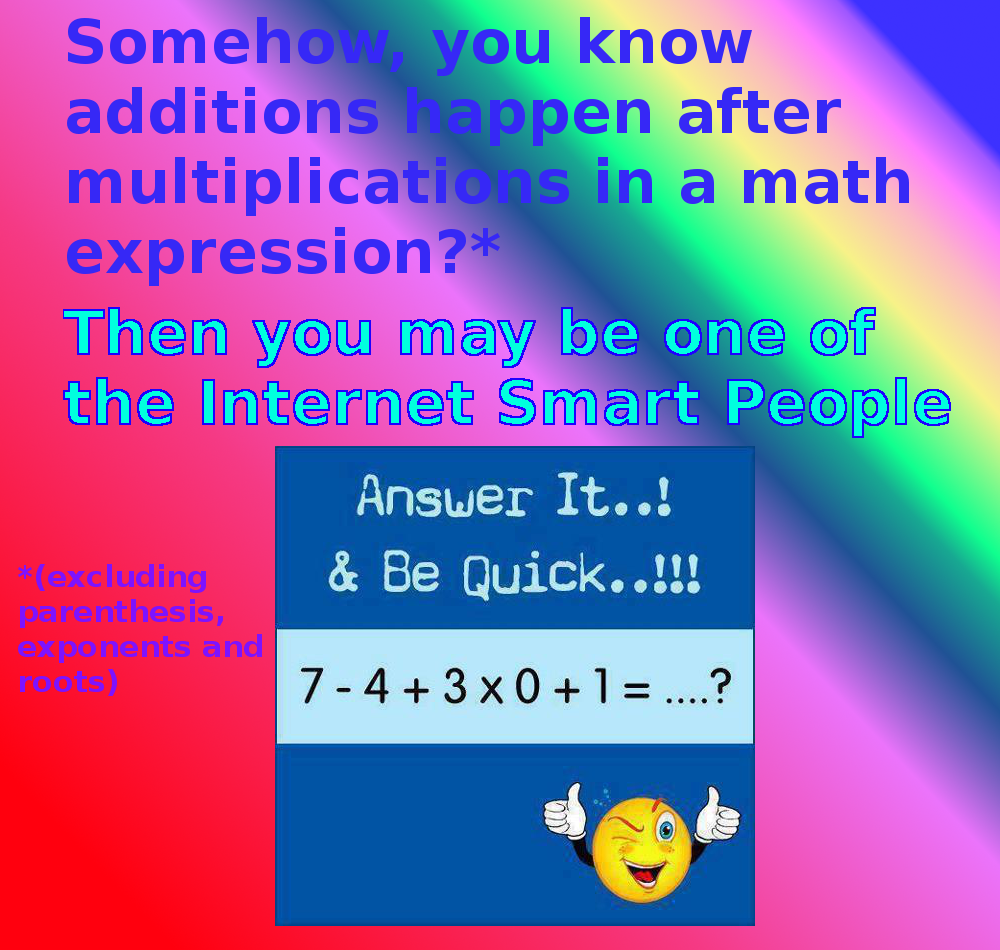
Facebook IQ test
Aah… Internet arguments. Such a beautiful, wonderful to behold manifestation of human intelligence and deep reflection, cutting deeper and deeper into the layers of thought as our collective intelligence slowly aligns to clearer and clearer ideas and consensus… Consensusis? Consensi or whatever.
So you like to have your opinion challenged, view things from different points of view and try to understand why people seem to feel THAT MUCH about something that you personally have not considered before or do not really understand fully from your perspective? Great. I think this is healthy behavior, thanks for pushing the human race further.
Some people say we're the sum of our experiences. Well I think we are the sum of a WHOLE BUNCH of experiences from a lot of different people. Don't we try to align ourselves, pick what we like in individuals we meet and try to emulate that, try to be better persons in our own way by learning through the wide spectrum of different ideas we have access to? At least I do. But you don't care about me and that intro sucks. I was going to add a bunch of pop culture references to make it cheaply funnier but no, sometimes it's no fun guys. IT'S NO FUN AT ALL.
Anyway, the goal of this article is to point out some of the most prominent parts of Internet argument vocabulary. 15 years old Call of Duty players on Twitter never use those terms, so there's your chance to finally be special by starting Internet arguments with them.
There are others but I felt like those were a good start and it took me way too long to write this stuff and I'm lazy.
Euh... Pourquoi c'est en anglais?
La plupart des débats sur Internet se font en anglais. Ces définitions seront beaucoup plus utiles aux trois personnes qui vont lire cet article si elles sont dans leur habitat naturel.Wait what's an Internet argument?
It goes like this:-
Someone posts an article/forum thread/tweet/Facebook propaganda/critique-of-some-piece-of-art-or-entertainment-that-really-has-no-bearing-to-important-real-world-events-and-won't-suddenly-result-in-the-creation-of-150-universities-in-Africa ;
-
You read the piece. You don't like it, maybe because of cognitive dissonance from your part but forget about that, you need to do something about it, for Internet justice ;
-
You write your own piece in response and send it to the the other person. To disprove their arguments and look smarter and tough, you need precise jargon and techniques to destroy your opponent(s). You don't want a discussion, you want to drown them in pointless drama infused smart-people lingo ;
-
What follows may depend on the situation, but it may just be that person 1 will read your piece, won't like it, and will repeat the cycle, if possible using other Internet argument terms than the one you've used.
It can also go like this:
-
You post a stupid joke or make fun of something ;
-
Someone doesn't like it, they will tell you how much you're just using a strawman ad hominem to help you through the incredible level of cognitive dissonance you have and how people like you are the reason why we can't have nice things, ever, and that it's well known Hitler said the exact same thing you did once to a prison mate that later became a serial killer that also abducts and molests wild ducks, which is also how we got the H1N1 virus threat some past year. And also, you're wrong.
The modern day equivalent of religious debates with massacres and all that stuff is various ideologies clashing in 160 characters max. It's ugly.

Meme status of Internet arguments is confirmed
Can you give me an example?
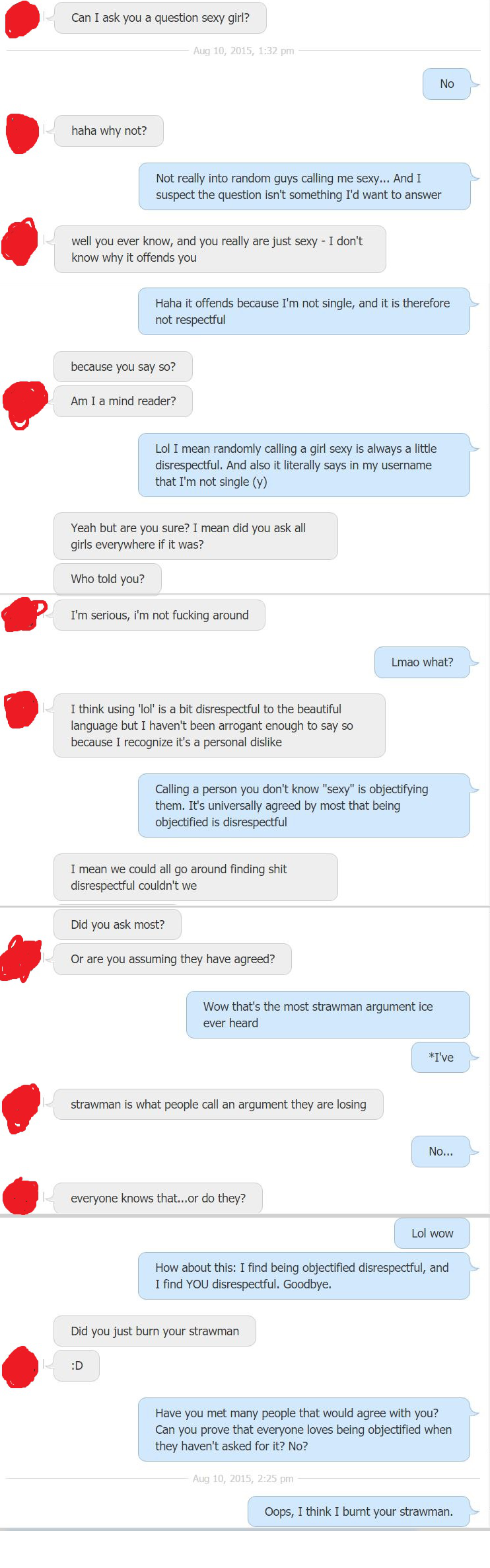
Sure. I found this online conversation on Imgur (source) and decided to lend all my mighty analysis resources to get to the bottom of this case. I hope the person that posted this agrees with me using it. Since it's not exactly art (well stupidity can be art if it's pushed so far it gets unreal) and has no names cited, I would assume so. I would also assume it's the women in the conversation that posted this because the dude clearly lost the argument and looked stupid even before the Internet Debate Jargon was used.So here goes:
True pick up artist right here
Some dude comes up and starts a chat with a girl with an opening that looks like "hey sexy, [...]". The other person (hereby referred to as THE WOMEN) rightfully feels like it's creepy to chat people up when you don't know them and refer to them as "sexy" or anything related to the size of your mammary glands or your hip-waist ratio. Yes some people feel like that, I don't like to have a hot girl I don't know about telling me I'm super hot and she has a question either.
This is where Internet argument happens. THE WOMEN could have just told him:
You know you're never going to get laid, ever, if you talk to other people like this. Unless you're like, Hugh Jackman and the girls you're chatting with know you really are Hugh Jackman.
But instead she went on about how he's objectifying her and that's not cool. He may or may not have masturbated using her profile pic, that's just regular male occupation. I personally don't think it needs a fancy word like "objectifying" but I have no say in feminist theory.
Whatever, after more of the dude already looking stupid, he asks her, in other word, if she really does have scientific data proving that most people find objectification (whatever that is) disrespectful after telling her that "lol" can also be disrespectful because Shakespeare would not have used it even if he did live in the 90's.
This mess pretty much allows any of the Internet Debate terms to be used here. But she chose the Strawman.
Now the dude is taken aback by the Internet Argument abilities this sexy girl is showing and is like "holy shit what am I going to do now?".
Quick note here: notice how she said it was the most strawman argument she has ever heard (didn't even know you could say that). This may seem like an excessive addition but the subtle (lol) aggressivity implied will trigger a visceral reaction in your opponent that will possibly cause them to overextend and say (more) stupid shit. And then you win free usage of more of the Internet Argument exclusive vocabulary and win. It's war out there guys, you need every little thing.
He then goes on about how she's just using that term to look smart and that strawman is used when you lose an argument (wrong: it's used anytime in an argument, even when you're winning by definition, you want the other to BURN).
This retort could have warranted a DARVO from her (explained later in this article) but she smartly decided to end the "conversation".
See, this is Internet argument in action. It's completely pointless and uses a lot of complicated terms and ideas when it's pretty simple to summarize: the dude doesn't know how to interact with women on the Internet and doesn't care too. No, this does NOT require feminist theory. I'm sorry. But you want theories in your internet argument. The most people currently using those theories, the better.
A few useful terms
I'm going to define a few so you know what to use and when.Cognitive dissonance (and confirmation bias)
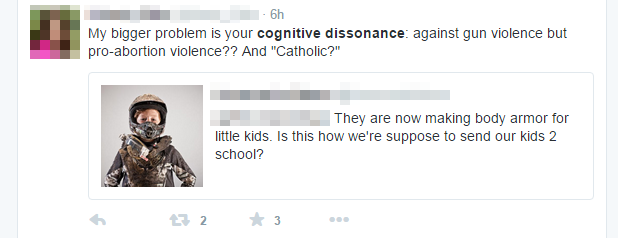
You can't be against guns and pro-abortion because one kills people and the other kills foetus people so there's a problem here, I think??? Uh? Also Catholic? Aren't they pro-foetuses (pro-foeti, pro-feta, I don't know)? I'm so confused.
Cognitive dissonance is when someone feels like you're contradicting yourself with mutually exclusive arguments or ideologies, or when someone is apparently upset about something they read or saw that contradicts a belief they have. Internet people love to pick on those guys.
In theory, it's somewhat linked to confirmation bias, in that humans are stupid and tend to want polar alignment of their thoughts and ideas. What I mean by that is that our brain wants yes or no, black or white, not maybe or poopy brown. Ever noticed how many things in life are full of gray areas and relative points of view and that your brain hates it? It does, trust me.
I think it may be linked to some of our ancestors never taking any decisions because there's too much data to consider (should I just run away or try to speak with this bear? Maybe it just wants to ask me for directions, maybe it's vegetarian?), and then proceed to get mauled by a bear. To take decisions we have to align rather quickly. It can be life-saving I guess but when you really need to have a smart discussion for important life-changing stuff like allowing people to buy assault rifles in the local supermarket, you need to carefully and slowly process all the ideas. It's a pain in the ass too so most people don't do it and prefer to watch other people debate in sensationalized ego battles.
Confirmation bias acts like a filter reinforcing some evidence or information, and devaluing other so that you align to some probably shitty and extreme belief but at least you have picked a camp and your brain is happy.
It's the whole reason why double blinded test exists and are required to test serious stuff in life (so it's not used for homeopathy for instance). Because if an experimenter knows which batch is the real thing and which batch isn't, they will usually unconsciously interpret the results to reinforce the belief they have or the desire for the experiment to work the way they want.
It's also the reason why people will sometimes look like they're fighting so hard for their beliefs. Cognitive dissonance can be very uncomfortable if you never felt it growing up.
This is all great and not funny at all and the source of a lot of mankind's awfulness factor and we're all subject to it, but in Internet arguments you just want to point the confirmation bias on other people (that's brain-ception right there, I told you).
In practice, you can throw the cognitive dissonance pretty much anytime there are at least two ideas brought in a post, it doesn't matter how unrelated those two things are, it's even better the more confusing it is.
The other way is to just respond to someone's comment about something (a book, video, article, whatever) they think is bullshit with just the term “cognitive dissonance” or “cognitive dissonance in action”. That's it, do not add anything else! This is great for Twitter because the other person will be hard pressed to find something smart to retort in 160 characters because for one thing they weren't asking for your opinion on.
Examples:
Joe: Guys I'm a christian and I just discovered Jesus was actually a jew Franck: Cognitive dissonance much?Phil: People claim homeopathy is bullshit but it just cured my diarrheaAnne: Yeah a lot of people do not have your cognitive dissonance though.
Maria: A lot of old tales have dragons in them, and we found reptilian bones in the ground, dinosaurs are dragons! Internet Smart Person: It looks to me that you have confirmation bias.NB: This is a real debate topic. Here is a 1 hour discussion I didn't watch on it: https://www.youtube.com/watch?v=rho47Mey0Ww
The Strawman

Sometimes you'll see arguments that actually are the very definition of strawman but they're not stupid arguments so you can't attack them with strawman, it's too basic. You probably need another term. Cognitive dissonance could be fine, you just need to find something in that person's opinion that is totally unrelated to the strawman and tell them you've never seen anyone with such a level of cognitive dissonance, it's unbelievable.
You can look up the actual definition of the strawman argument but it's convoluted and rarely used as such. You could use this simple logic right here:
-
Someone made an argument that you deem unfair, or it's against something you really like ;
-
That argument is a strawman.
-
That's it.
You can also use the strawman at absolutely every occurrence of argument where there is a part of interpretation in your opponent's argument. I think a small example is required for this one:
I hate clubs, you can't talk to each other because of the dubstep, the beer is super expensive and it smells like a mix between a gym and a chemical plant.
- Are you that stupid? That's a total strawman, you can't talk to each other because people don't wanna talk to you. Because you suck. You neckbeard virgin Perl programmer.
The strawman is very mainstream, you may want to add a cool gif to your argument to make it better.
The projection
Projection, in my modest understanding, is just that you have some kind of negative trait, and you claim that it's due to other people / things being just like that.In general, blaming other people, institutions, governments or whatever for your negative traits is considered projection.
You can make up a fake definition of it too, as projection is also often used when someone is using their own experiences as a benchmark for what other people are living and experiencing. I think that one is called "personal anecdote" or something like that, but projection is way cooler.
In theory it's kind of a deep psychological concept. A common example is someone cheating on their partner. Because they innately do not want to face the responsibilities or conscientiously think about it, they let their brain create the narrative that their partner must be cheating too and probably has always been. That's the true, psychological projection.
In Internet debates though, you can just invalidate anything someone says about their personal experience with the projection argument. It's extremely easy to use because most people talk about themselves or their own experiences. Especially on something like a blog where the very existence of the medium is to project your ego all over other people's faces. Very prematurely too.
Ad hominem
That's when you're attacking the person making the argument instead of the argument. Wow that one was surprisingly easy wasn't it?It's also very convenient when you don't like the tone of the person arguing against you, you could call ad hominem. To avoid having the ad hominem card used against you, you can simply be the most condescending asshole you can while avoiding any direct mention of the other person.
You want to be just borderline outrageous. If the other person calls you out for being an asshole, BOOM, ad hominem. That's how you win at Internets.
Sophistry

Current day sophist (kinda looks Greek too)
The other closely kept secret advantage of the sophistry is how vague it is.
In all of it's splendor, the sophistry itself, in its true form, is akin to homeopathy. It looks like a real medicine, it's made by people in lab coat in some sterilized environment and has a weird names like “Chloramphenicolum” so that it looks like real medicine. In fact it's just pure sugar that someone shaked for a while.
The sophistry is that in essence. It looks like a plausible argument, but it's a trick, it's made to mislead you by manipulating the information you are given or trying very hard to appear more legit than it really is.
In Internet argument however, you can just use sophistry instead of strawman when you've already used strawman, or when your opponent did.
It also comes in handy when someone is really using a shitty argument or manipulating information but you're too lazy or just too smart to explain why.
Real life sophists were actual Greek guys (they don't talk too much about women for some reason) who thought that demagogy was a great tool to manipulate people and that was one of the foundations of ancient Greek democratic systems. You could picture it as a whole bunch of Donald Trumps but wearing robes and shit. Plato hated those guys, also because they gated their political science and M.B.A. courses through a huge paywall because of course they did.
Correlation doesn't imply causation

Made some artwork nobody asked for and put it here
That's actually a really good thing to remember as it's tied to confirmation bias and is a very scientific way of thinking. Our brain doesn't like it because it's looking to confirm one side and disprove the other, it hates having some sort of balance between the two.
I bet your brain is having issue processing the phrase itself right now: “Correlation doesn't imply causation”. Damn it! Just having some things or events look like they're linked together, doesn't mean they actually are for sure or that one caused the other.
It's very useful in Internet debates because in any argument that is not a scientific publication you're going to have to cite things you've observed. Anything that is not a scientific publication can be disproved using statistics-related jargon like the one we're talking about in this section.
Another one is the personal anecdotes. When anyone relates their own experiences you can just say that's their own experiences, it doesn't paint any global trend.
I don't like this one particularly because it really does invalidate pretty much all Internet arguments. The only way to kind of avoid it is to present your argument as “OK so I have this theory […]” and asking if someone has experiences that would invalidate the theory. But it then looks like peaceful, calm and reasonable discussions about how we perceive things around us with an open mind, and that's not an Internet argument in which by definition you're supposed to take sides.
In conclusion we may be comparing apples and oranges here, but it doesn't matter. Statistical fallacies are very powerful in debates.
DARVO
DARVO is a relatively recent abbreviation that I think was coined by some judge somewhere at some point. It doesn't matter.DARVO stands for “Deny, Attack, and Reverse Victim and Offender”. You could say it's just classic manipulation, I don't see why it needs another name. DARVO came up because this tactic is often used by convicted criminals.
On the Internet, it's often used against people who've shown aggressive behavior towards someone or a somewhat cohesive group of people, after they criticized the response from the group they were attacking as overly aggressive themselves.
I think we need one of these typical scenarios that I've clearly proven how good I was at writing them:
-
Person A starts an internet argument with person B (swap person with “group” or “ideology” or “religion” or “political party” if you want, it works the same (now that I think of it, the grouping of those terms is slightly striking)).
-
Person B doesn't like it. Retaliates somewhat aggressively.
-
Person A responds, saying they don't like the tone used by person B (good opportunity to use Ad Hominem here) and that all they've done is write a reasonable critique.
-
Person B responds: “Unbelievable how these people use DARVO tactics thinking we won't notice.”.
The thing is, is doesn't matter who was aggressive or not and how the tone of person A measures up with person B, if person A is only slightly putting themselves as some sort of victim of injustice, harassment, Ad Hominem (yeah, that) or others of that kind, DARVO can be used against them.
In reality it's just an observed behavior of criminals when they know they're in pretty deep shit, a classic reaction is to explain how much of a victim they were and that something pushed them to become criminals, and that they too are victims (sometimes they'll try to push that they're the "true" victim). Which in a lot of cases is not 100% false, it's just that they're trying to get away from their own responsibility, and that's wrong.
So some people really do that on the Internet? Well yeah, but they're not criminals (I think). DARVO shouldn't be used in that context ever, but I'm not the authority you know? The level of deep shit of being found out to be wrong on the Internet is not exactly the same as finding 33 human heads in your refrigerator.
Some free life advice (you'll thank me later): if you see someone you know claiming to be the victim after doing something frankly questionable, be careful. Those people are usually ready to sacrifice a lot more to avoid facing responsibility, their brain will "save" them at any costs and you have no ideas what kind of collateral damage it may result in.
False dichotomy

He has a point. I would also have mega-bars full of kitten and trappist beer pleasee
False dichotomy is another manifestation of how our brains want strict polar opinions. Positive or negative, black or white, left-wing or right-wing or it can be a manipulation tool in that it consists of lying by omission.
When you're using a false dichotomy yourself, you're presenting two alternatives or ideas as if those were the only possibilities. In reality, there may be more possibilities or nuance to all of it.
Our world is analog and full of nuances and possibilities.
Now for Internet debate purposes it's much easier to use than it looks. Anytime someone proposes two sides to something, you can usually claim false dichotomy because there's certainly more to it than just two fully-defined sides (unless you were talking mathematics but that's no Internet debate (I think)). You don't even have to stick with the “two-sides” definition, if more ideas are being used, you can still claim false dichotomy because there's more to it.
In the great Twitter example above, you can see how it's easy to use the false dichotomy even when it's a really stupid point about mega-churches (that sounds AWESOME). The original poster could have explained "yeah well you know, resources and time are finite, so maybe we should prioritize mega-shelters or just put homeless people in mega-churches, what do you think?" but instead he caved in to the mighty power of the false dichotomy. I have tears in my eyes. Also you can't really argue in 160 characters but that's part of the beauty of all this. Thanks Internet.
More examples:
But in reality you can just move to a rich country, land a great job at a bank and stop caring about politics.I hate politics, if we vote for X we lose, and if we vote for Y we don't win. We're f*cked.
There is a really weird other fallacy somewhat linked to the false dichotomy. I don't include it as a full section because it's… Well it's stupid. It's called the balance fallacy or the “there must always be a middle ground” fallacy. I've seen an example somewhere that made me laugh out loud so here goes:
So that's a balance fallacy. You got two “extremes” which in the example here are two unrelated people's opinions and you outright say the “right thing to do” must be somewhere between the extremes, because extremes suck. It's basically treating something as analog, when it's discrete. Yeah I knew you'd like that analogy.“Bob says we should buy a computer. Sue says we shouldn't. Therefore, the best solution is to compromise and buy half a computer.”
You see, extremes suck when you see those extremes as the only things that exist and completely reject any gray areas or the fact that it may just be a huge gray area with minuscule black and white dots at the extremes. When you craft a funny examples where the alleged “extremes” are effectively the only viable possibilities, then yeah alright you have done a balance fallacy, congratulations.
I can craft my own too:
Being racist is bad, not being racist is good but you can't prove that you're not racist, so let's just assume we're a little racist because we have internalized evil ideas related to the quantity of melanin in someone's skin cells.
Red Herring
The red herring is quite uncommon as many other terms can be used instead, in the context of Internet arguments. For instance, strawman is a very common replacement.Let me tell you the alleged story behind the red herring. So there was this guy training hunting dogs. He bought some smoked herring (the flesh of it being red in color) and scattered the dead fish all around in some forest. Then he had the dogs trying to find prey. The fish had such a pungent scent that it would falsely lead dogs to go to the fish (then regret it later on). Hence the “red herring” being kind of synonymous with “false trail”, or “misleading element”. And there isn't much more to say really.
When it looks like someone is trying to hide the evidence that they're wrong and lead people elsewhere, it can be assumed to be “red herring” tactic. But really just don't bother and use strawman or false dichotomy or whatever. Red herring can confuse people and doesn't sound as smart as the other terms as herrings are sort of repulsive to most people except some during the carnival of DUNKERQUE.

I stole this pic without permission but I'm sure the dude would abide
Donald Trump (yeah this guy gets cited a lot but it's relevant to current times) described a similar tactic called “anchoring”, where you use a strong (stupid or offensive works better) idea to anchor the audience on, and then you can do and say whatever you want the audience will be stuck on the anchor and have a strong impression of the on-screen character after shutting down the TV. It's not really red herring per say but it's putting an irrelevant idea or topic on emphasis when it's really not the most important topic to have there.
I'm not making this up, the guy wrote a book on manipulation techniques: http://www.amazon.com/Trump-The-Deal-Donald-J/dp/0345479173
Tu Quoque
The tu quoque is very rarely used as a term. Mainly because it sounds really stupid and people do not know how to pronounce it (what is that even? French?). It's also, again, easily replaceable with other terms. The tu quoque itself (not pointing it out, using it (without knowing what it is, usually)), is used a lot on the Internet so it warrants a section about it because of that fact alone.It's pronounced TWO KWOKWAYY which is downright ugly in itself. If you want another easy definition, the art of tu quoque consists in finding or downright inventing hypocrisy in someone.
Here are some quick To Quoque examples that will tell you everything you need to know about it:
Person A: it seems to me that you're using cheap tactics to get ahead of the debate. Person B: Your mom is a cheap tactic
Person A: the Eiffel tower is kind of phallic, isn't that art style outdated? Person B: you know you have a phallus in your own pants. And it's outdated.
Person A: you should stop smoking, it stinks too. Person B: like you're one to talk, you play Candy Crush.
Person A: guns kill people, there should be gun control. Person B: come on, we all know you have a catapult in your basement.
It's beautiful because you're ignoring the actual argument and finding some cheap way to attack the opponent with allegations of hypocrisy. Because of that, the Tu Quoque is often said to be a variation of Ad Hominem, which you can use instead (it sounds better). Remember, Internet Arguments are about burning people down so that they're afraid to come up with more and start reading articles about Internet Argument jargon like this one instead to be ready for the next time.
Some actual journalists use Tu Quoque and dig into the past of personalities to invalidate their current opinions. This is part of the reasons why you shouldn't send pictures of your reproductive organs to other people, because journalists will find them and that will invalidate all your opinions, on anything, for the rest of your life, even and especially if your carreer doesn't have anything to do with penises and vaginas. This is also hands down the best advice in this article and a good way to close the discussion.
Commentaires
Il faut JavaScript activé pour écrire des commentaires ici